
This is the sixth post in our Cold Email Myths series, where we take the things everyone repeats about cold email and check them against how people actually read.
The thinking goes like this: the prospect doesn’t know you, so you need to explain everything. Who you are, what you do, your features, your clients, your story. The more you put in, the better your chances.
In practice, the opposite happens. A cold email isn’t a sales page. It’s a message from a stranger, read in a few seconds, usually on a phone. Its only job is to get a reply, and length works against that.
What is the ideal cold email length?
For most first-touch cold emails, aim for 50 to 125 words: short enough to read without scrolling on a phone, long enough to show you did your homework. Follow-ups can be even shorter.
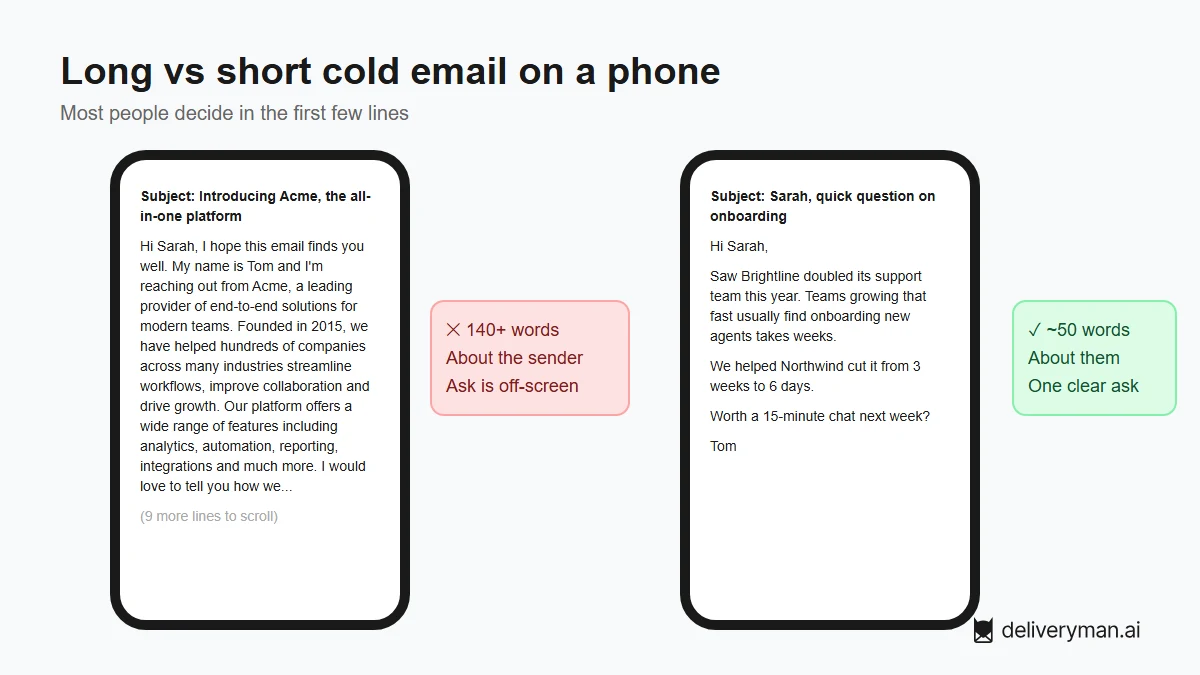
Why longer cold emails get fewer replies
1. People decide in the first few lines
The preview and the first two lines decide whether the rest gets read. If those lines are “I hope this finds you well, my name is…”, most readers are already gone.
2. Most cold email is read on a phone
A paragraph that looks short on a laptop becomes a wall of text on a phone. If the reader has to scroll to find out what you want, they usually won’t.
3. Long emails are about the sender
Extra length almost always means more about you: company history, feature lists, awards. The prospect only cares about one thing: whether you can help with a problem they have right now.
4. More asks mean no answer
Long emails tend to pile up calls to action: book a demo, check the website, watch the video, reply if interested. Every extra option makes it easier to do nothing.
5. Heavy emails look more like marketing
Long, link-heavy, formatted emails look like newsletters, both to people and to spam filters. A short, plain message looks like what it should be: one person writing to another.
The anatomy of a short cold email
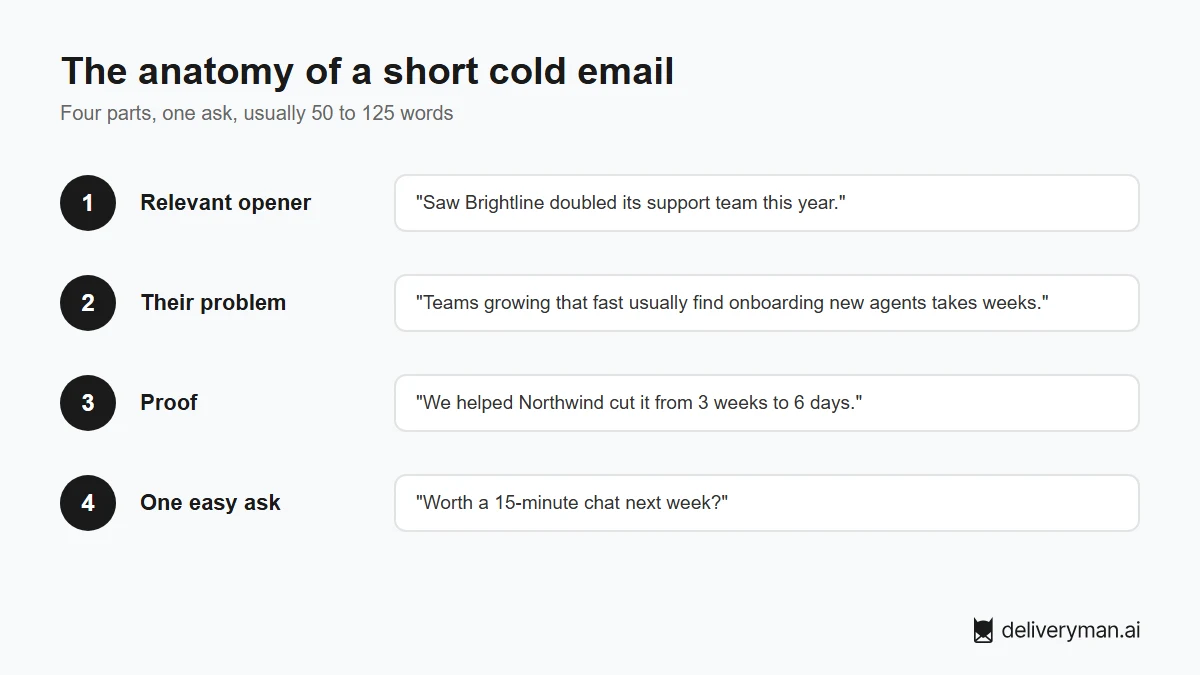
- A relevant opener. One line that shows why you’re writing to them: a hire, a launch, a post, a change in their business.
- Their problem. One line naming a problem people in their position usually have.
- Proof. One concrete result for a similar company. A number beats an adjective.
- One easy ask. A simple question that’s easy to say yes to.
Before and after: cutting a long cold email
Before (140+ words, shortened here):
Hi Sarah, I hope this email finds you well. My name is Tom and I’m reaching out from Acme, a leading provider of end-to-end solutions for modern teams. Founded in 2015, we have helped hundreds of companies streamline workflows, improve collaboration and drive growth. Our platform offers analytics, automation, reporting, integrations and much more… Would you be open to a demo, or feel free to check out our website and case studies?
After (about 50 words):
Hi Sarah,
Saw Brightline doubled its support team this year. Teams growing that fast usually find onboarding new agents takes weeks.
We helped Northwind cut it from 3 weeks to 6 days.
Worth a 15-minute chat next week?
Tom
The second version says less about Acme and more about Sarah. It also fits on one phone screen, with the ask in view.
When a longer cold email makes sense
Short is the default, not a law. A bit more length can work when every extra line is about the prospect: a specific observation about their website, a short audit, or a concrete idea for their business. Length that adds relevance can help. Length that adds information about you rarely does.
Short emails still have to be relevant. Our two case studies on Deliveryman reached a 46.12% reply rate (case study) and a 22.66% reply rate (case study) with focused, prospect-first copy, not long pitches.
Quick cold email length checklist
- Keep first emails between 50 and 125 words.
- Cut “I hope this finds you well” and your introduction.
- Make the first line about them, not you.
- Use one proof point, not a list of clients.
- Ask one question.
- Read it on your phone before sending.
- Save details for the reply or a follow-up.
FAQ
How long should a cold email be?
Most first cold emails work best between 50 and 125 words. That’s enough for a relevant opener, a problem, one proof point and one ask.
Are short cold emails better?
Usually, yes. Short emails are faster to read, fit on a phone screen and make the ask obvious. They still need to be relevant. A short generic email gets ignored too.
How long should a cold email subject line be?
Keep it short, around two to six words, so it isn’t cut off on mobile. Plain and specific beats clever.
How long should a follow-up email be?
Shorter than the first email. A few lines that add one new reason to reply is enough.
Next in the series: Cold Email Myth #7: One Email Is Enough.
Write the short email. Deliveryman makes sure it lands. You bring a domain, and it sets up 15 warmed-up mailboxes with SPF, DKIM and DMARC, verifies your list and spreads your sending so no mailbox carries too much. See pricing.