

This is the seventh post in our Cold Email Myths series, where we take the things everyone repeats about cold email and check them against how prospects actually behave.
Nobody likes being chased. So a lot of people send one cold email, hear nothing and move on. Following up feels pushy, and if they were interested, they would have replied, right?
Not really. Silence after one email almost never means “no.” Usually it means “not now,” “didn’t see it” or “meant to reply and forgot.” A cold email follow-up is often where the conversation actually starts.
Why one cold email isn’t enough
1. Inboxes are busy
Your prospect gets dozens or hundreds of emails a day. Yours might arrive during a meeting, get buried by lunch and never be seen again. A follow-up gives it a second chance at a better moment.
2. Timing beats copy
A perfect email on the wrong day gets ignored. The same idea a week later, after a budget meeting or a bad quarter, can get a reply in minutes. Follow-ups give you several shots at the right timing.
3. People reply to familiarity
By the second or third email, your name is no longer brand new. A short, polite sequence feels more like persistence from a real person than a one-off blast.
4. Many replies come from follow-ups
Across most cold email campaigns, a large share of replies arrive after the first email, not to it. Stop after one, and you never see those replies.
How many follow-ups should you send?
For most B2B cold email, three to four follow-ups after the first email works well, spread over about three weeks. Space them further apart as you go.
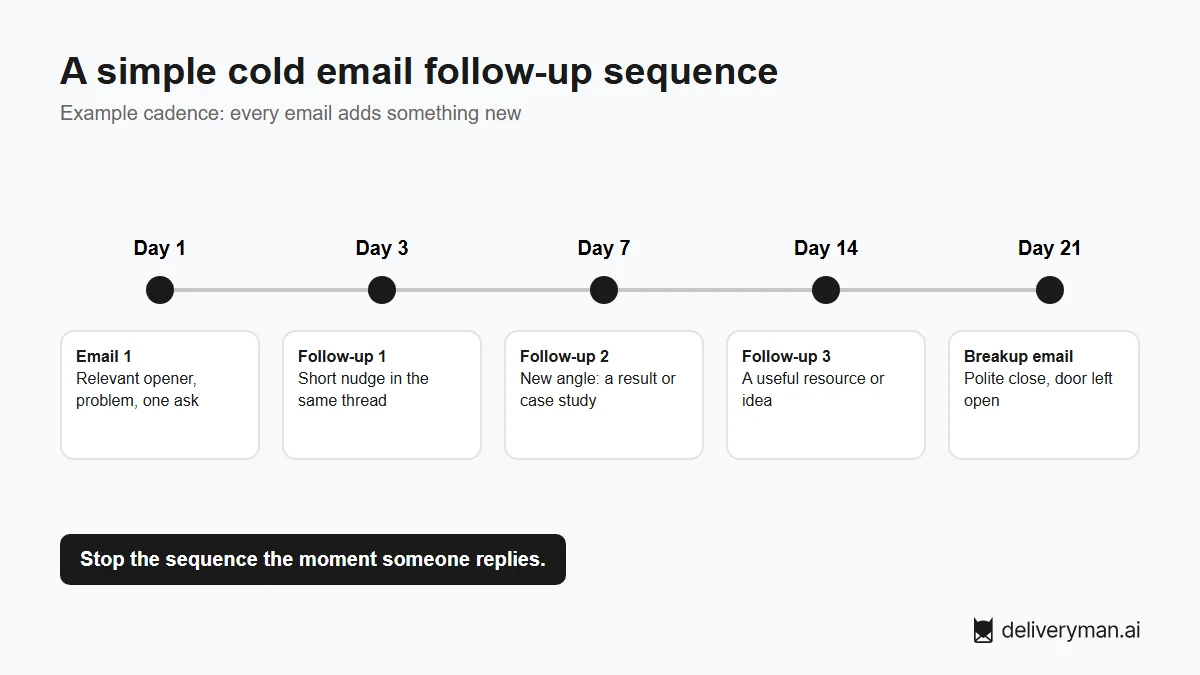
| Step | When | What it adds |
|---|---|---|
| Email 1 | Day 1 | Relevant opener, their problem, one ask |
| Follow-up 1 | Day 3 | A short nudge in the same thread |
| Follow-up 2 | Day 7 | A new angle: a result or case study |
| Follow-up 3 | Day 14 | A useful resource or idea, no strings |
| Breakup email | Day 21 | A polite close that leaves the door open |
What to say in a cold email follow-up
The rule is simple: every follow-up should give the prospect a new reason to reply. “Just checking in” doesn’t.
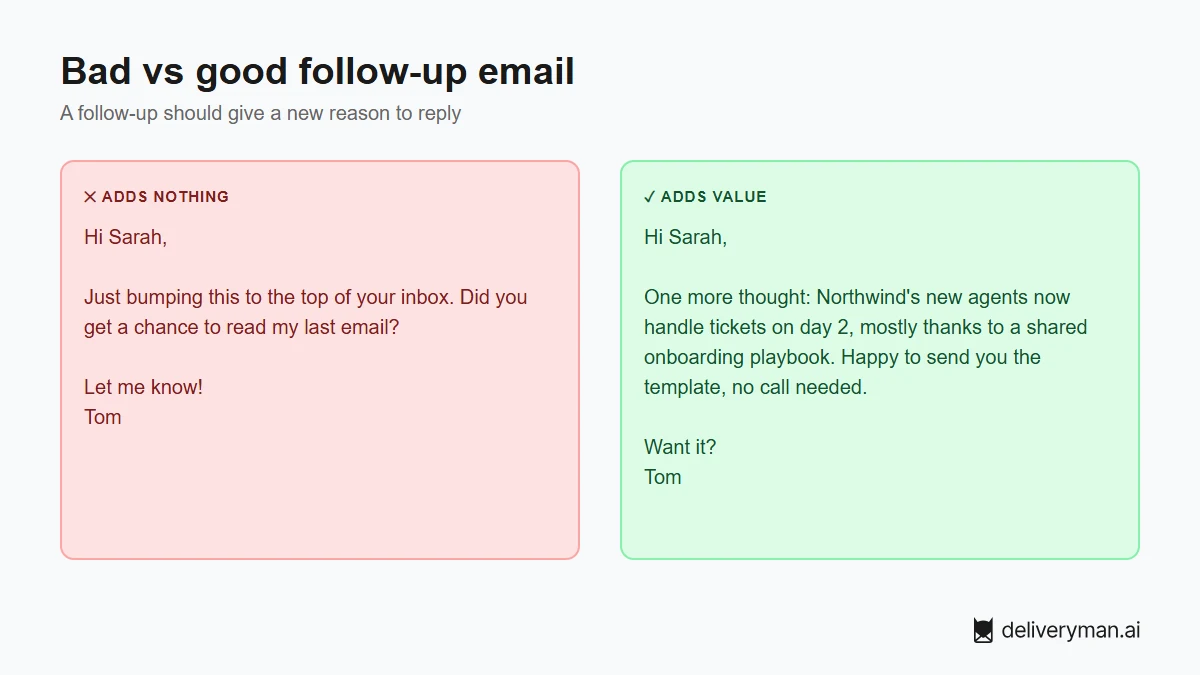
Follow-up examples you can adapt
Short nudge (day 3):
Hi Sarah, quick nudge in case this got buried. Is onboarding speed something you’re working on this quarter?
New angle (day 7):
Hi Sarah, one more thought: Northwind’s new agents now handle tickets on day 2, mostly thanks to a shared onboarding playbook. Happy to send you the template, no call needed. Want it?
Breakup email (day 21):
Hi Sarah, I’ll stop here so I don’t clutter your inbox. If onboarding becomes a priority later, just reply to this email and I’ll pick it up.
Follow-up mistakes that hurt replies and deliverability
- Not stopping on reply. Nothing kills trust faster than an automated follow-up after someone already answered. Make sure your sequence stops when a lead replies.
- Following up too fast. Daily emails feel like spam and lead to complaints.
- Sending too many. After four or five touches with no response, more emails mostly lead to spam reports.
- Guilt-tripping. “I’ve emailed you three times now” makes the prospect feel bad, not interested.
- New thread every time. Replying in the same thread keeps context and looks like a real conversation.
FAQ
How many follow-ups should I send for cold email?
Three to four follow-ups after the first email works for most B2B campaigns. Stop as soon as the prospect replies or asks you to.
How long should I wait before following up on a cold email?
Two to three days for the first follow-up, then space the rest further apart, for example days 7, 14 and 21.
Are follow-up emails annoying?
Only when they add nothing or come too often. A short follow-up that brings a new idea, result or resource is usually welcome, and often the email that gets the reply.
What is a breakup email?
The last email in a sequence. It politely says you’ll stop reaching out and invites the prospect to reply if the timing changes. It often gets replies of its own.
Next in the series: Cold Email Myth #8: Open Rate Is Your Best Metric.
Build the sequence once. Deliveryman sends it from 15 warmed-up mailboxes per domain, with SPF, DKIM and DMARC set up, and spreads your sending so no mailbox carries too much. See pricing.