

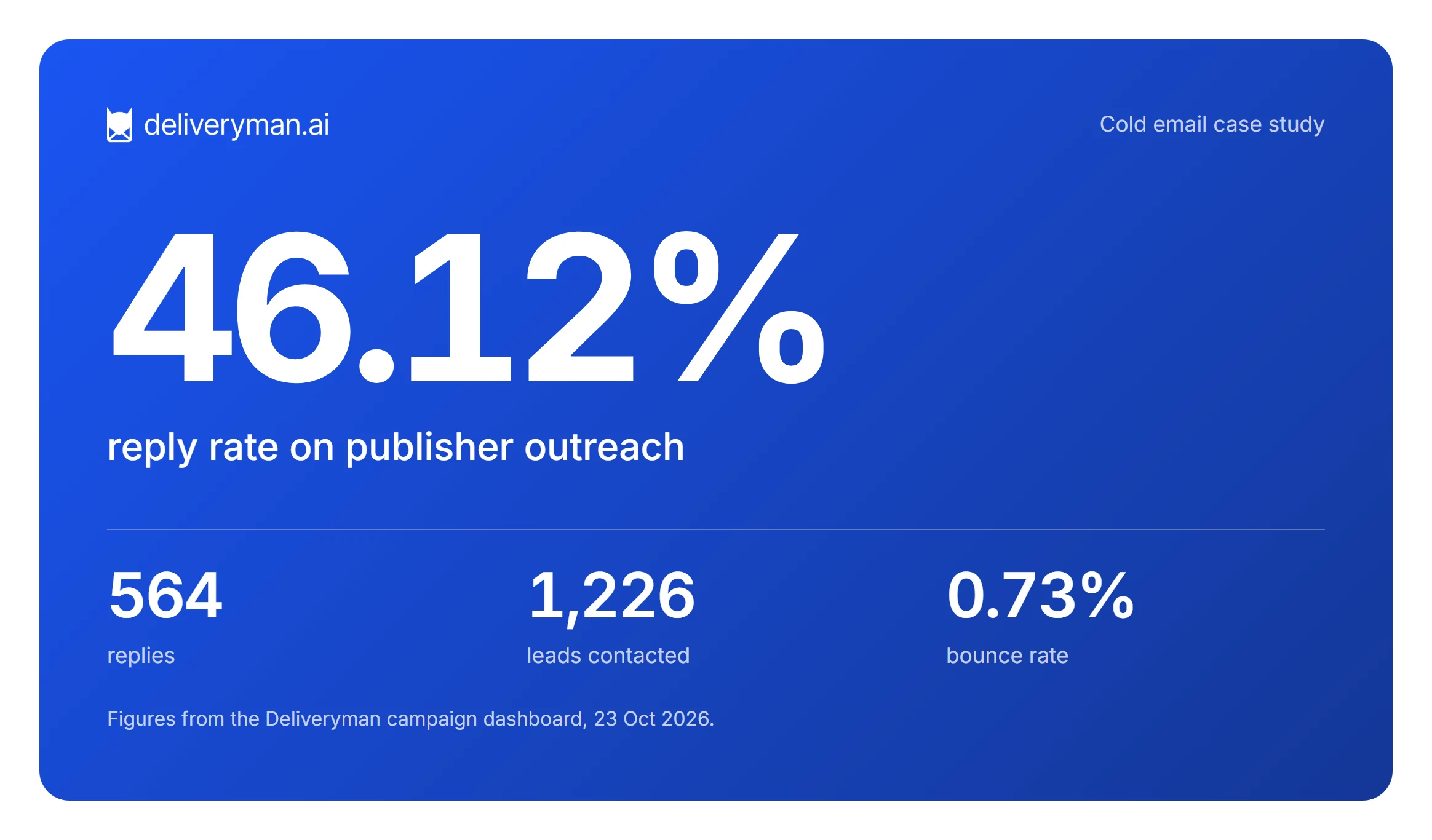
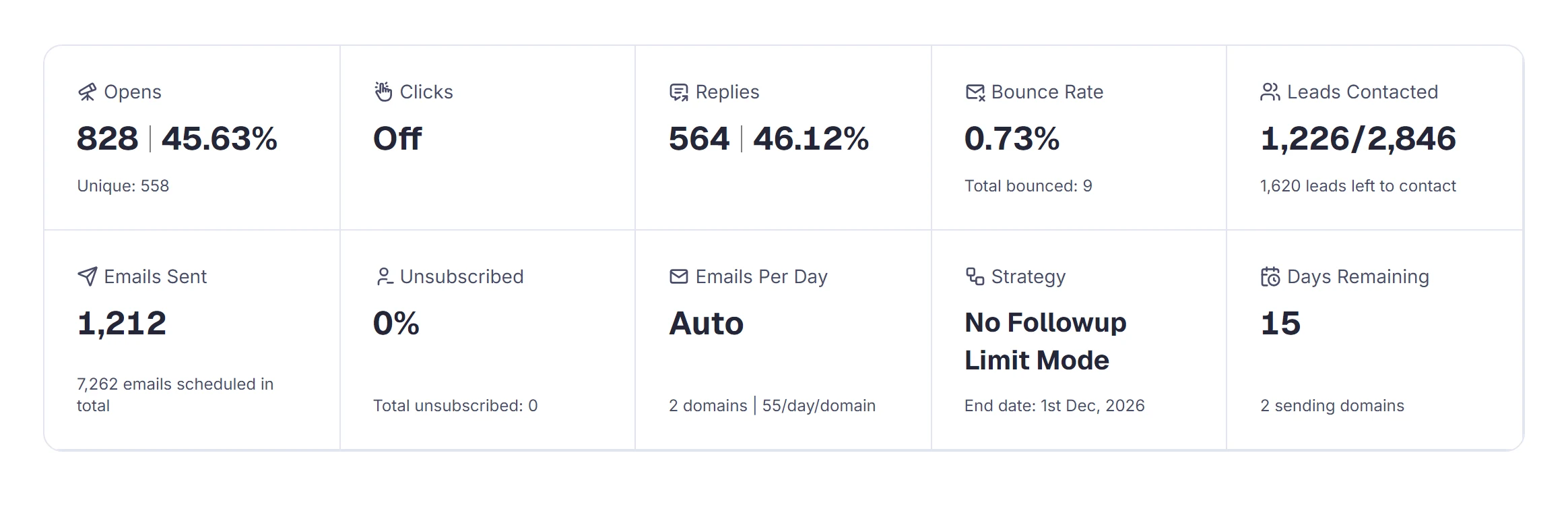
Most cold email benchmarks put the average reply rate somewhere between 1% and 5%. This campaign got 46.12%.
A B2B company contacted 1,226 independent publishers through Deliveryman AI. Two warmed-up domains, a verified list and a two-step sequence produced 564 replies, with a bounce rate of 0.73%. Every number in this post comes from the campaign’s Deliveryman dashboard.
Campaign Setup
| Client | B2B company (anonymous) |
| Audience | Independent publishers, bloggers and niche media sites |
| Sending domains | 2, both fully warmed up |
| Daily limit | 55 new leads per domain |
| Sending strategy | No Follow-up Limit Mode |
| Sequence | 2 steps: plain-text opener and rich-text follow-up |
| Sending window | Mon–Fri, 9 AM–8 PM (America/Los_Angeles) |
| Sending days | 12, from 25 Sep to 12 Oct 2026, then paused |
| Data as of | 23 Oct 2026 |
Getting a response from people who get pitched all day
The client needed to start conversations with independent publishers: bloggers, niche media sites and online magazines. These inboxes are some of the hardest in cold email. The addresses are mostly shared ones like info@, advertising@ and pr@, and they receive a steady stream of link requests, guest-post pitches and spam.
The team had three requirements:
- Land in the inbox across Gmail, Microsoft, Zoho and custom business domains, not in spam.
- Get real replies, not just activity. For this campaign the only success metric was the reply rate.
- Keep the infrastructure small. Two sending domains, with no burnt domains and no reputation damage that would cut the campaign short.
How the campaign was built
Four decisions, all made before the first email went out.
- Sending domains: 2 domains, fully warmed up. Both were warmed up before the first email went out. Deliveryman spread the sending across several mailboxes on subdomains of each domain, so no single inbox carried the load.
- Contact list: 2,846 verified contacts. Mostly shared publisher inboxes. Every address was verified before launch, so invalid ones never reached a sending mailbox.
- Two-step sequence: both emails scored 100/100. Email 1 was a short plain-text message with the subject line “7 new orders ready”. Email 2 was a rich-text follow-up, sent only to people who hadn’t replied. Click tracking was off, so no tracked links appeared, and every email carried an unsubscribe link.
- Sending rules: 55 new leads per domain a day. The campaign ran in No Follow-up Limit Mode, so the 55-a-day cap applied to new leads and follow-ups went out on top. Emails went out Monday to Friday, spread across a 9 AM–8 PM Pacific window, with weekends off.
Close to 1 in 2 leads replied
The campaign contacted 1,226 of its 2,846 leads and received 564 replies, a 46.12% reply rate. This is the campaign overview exactly as the client sees it in the Deliveryman dashboard.
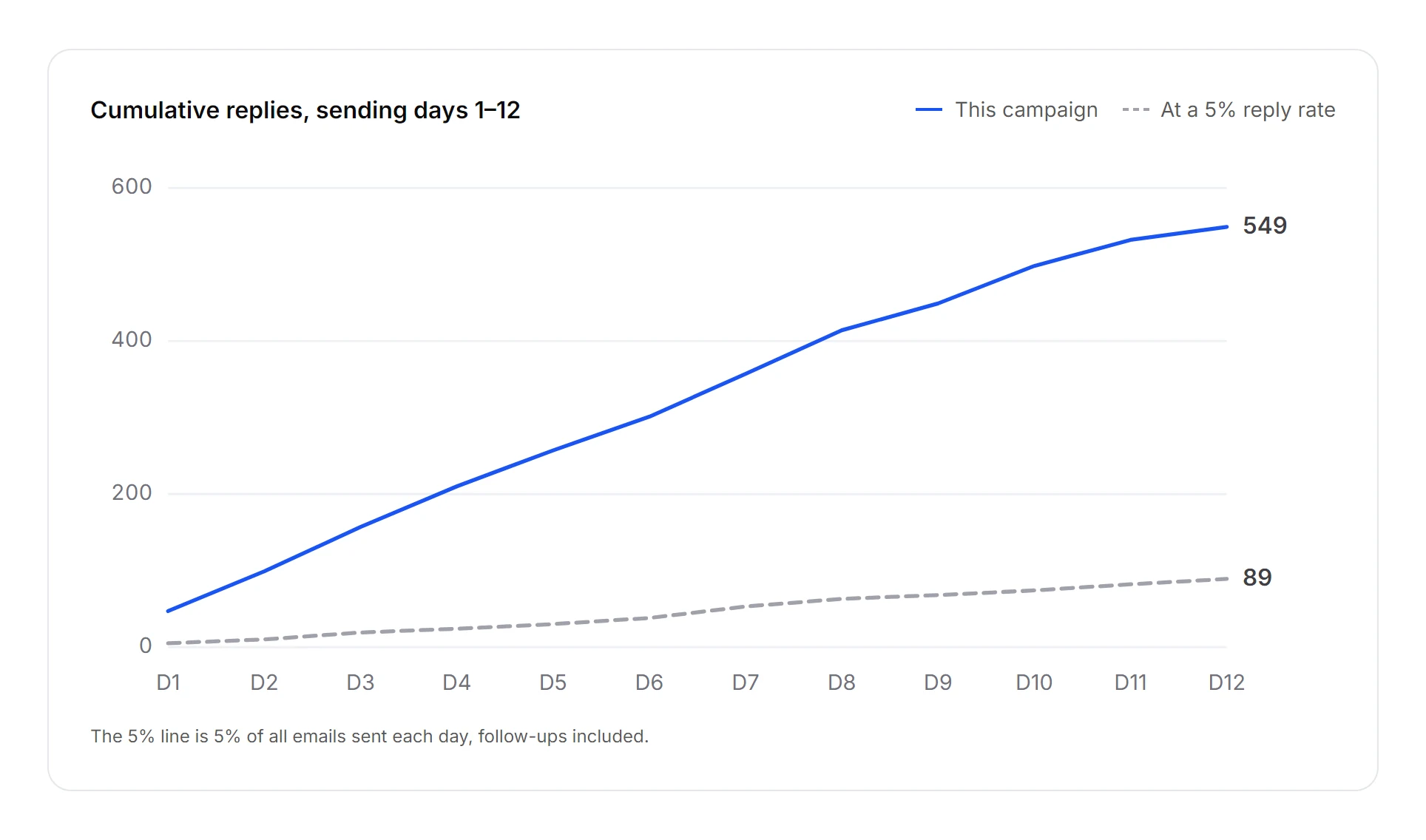
The chart below shows how far apart 46% and a typical campaign are. The dashed line is what the same emails would have produced at a 5% reply rate, the top of the usual range.
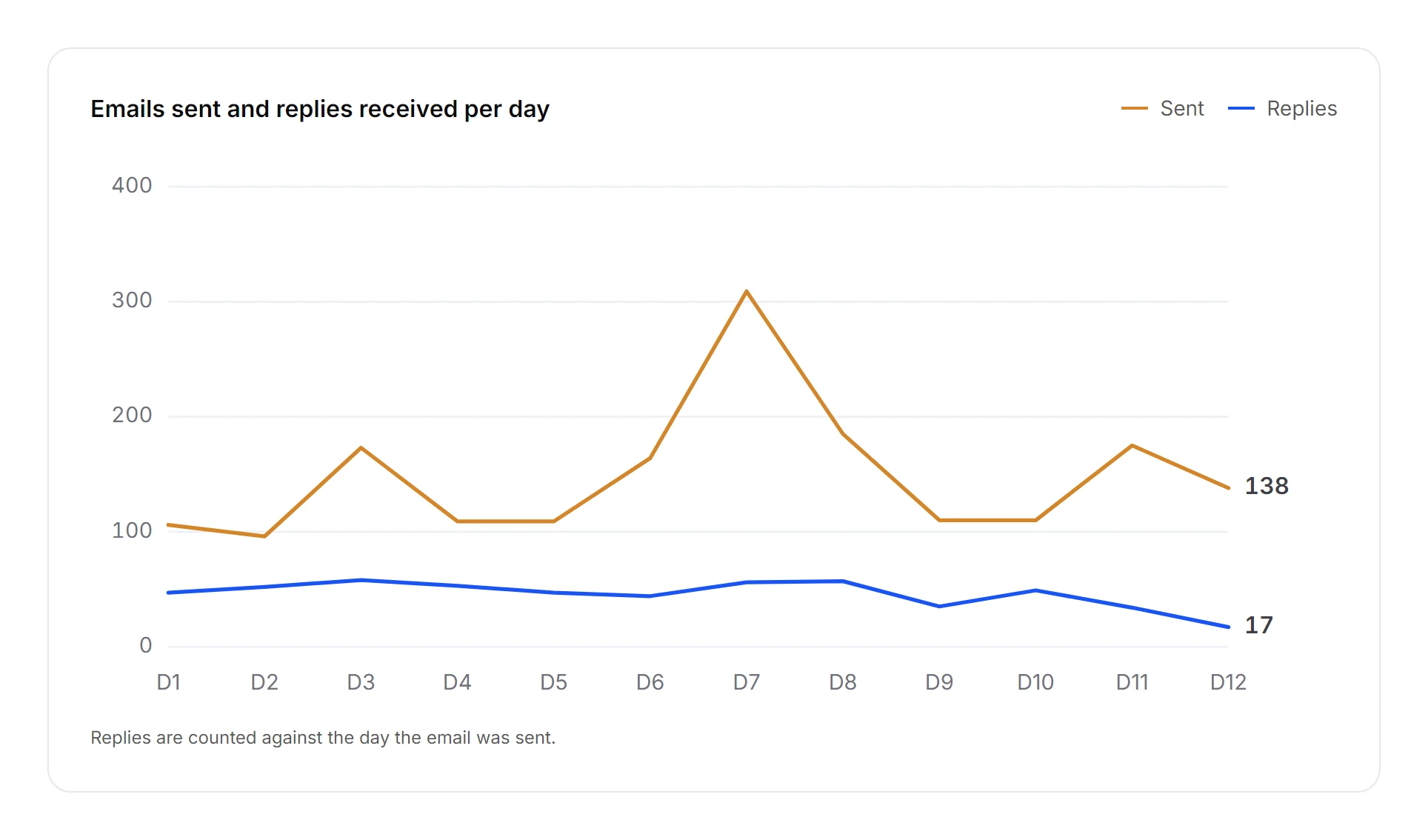
Replies on every sending day
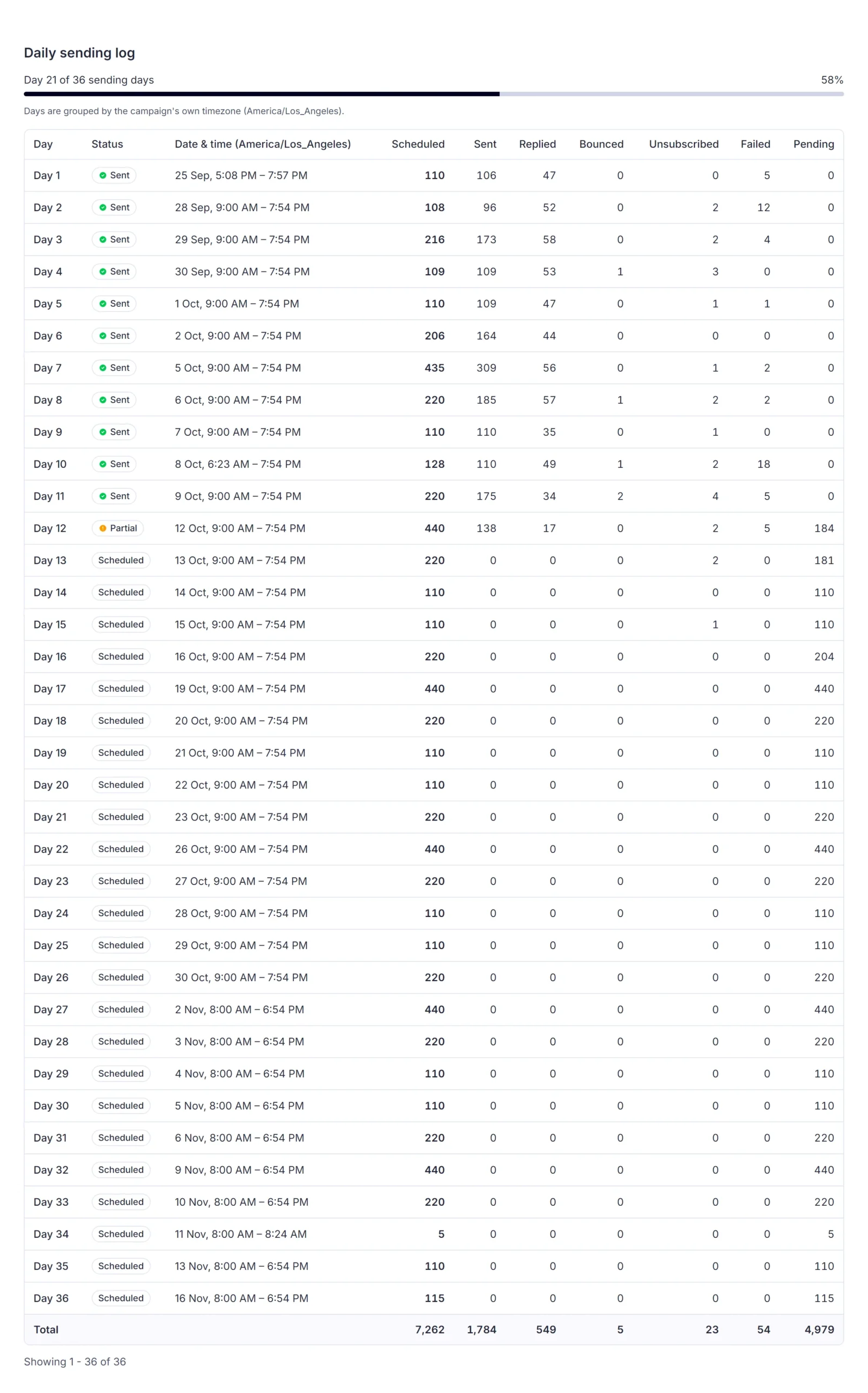
Replies arrived from the first day: 47 replies from 106 emails on day 1, and between 44 and 58 replies on every day through day 8. Days 3, 6, 7 and 8 carried follow-up emails on top of new leads, which is why more emails went out on those days without a matching jump in replies. Follow-ups get far fewer replies than first touches.
Here is the full daily sending log. Sending was paused on 13 Oct, partway through day 12, so the rest of the schedule shows as Scheduled.
The first email produced 98.8% of replies
When we read the sequence stats on 12 Oct, 554 of the 561 reply messages were responses to Email 1. Some leads replied more than once, so there were more reply messages than replying leads. The follow-up still had a job: it brought in 7 replies from leads who had ignored the first email, and it only went to people who hadn’t answered.
| Email 1 | Email 2 (follow-up) | |
|---|---|---|
| Format | Plain text | Rich text |
| Emails sent | 1,180 | 465 |
| Reply messages | 554 | 7 |
| Share of all replies | 98.8% | 1.2% |
| Spam score | 100 / 100 | 100 / 100 |
| Placement verdict | Inbox | Inbox |
9 bounces across 1,226 leads
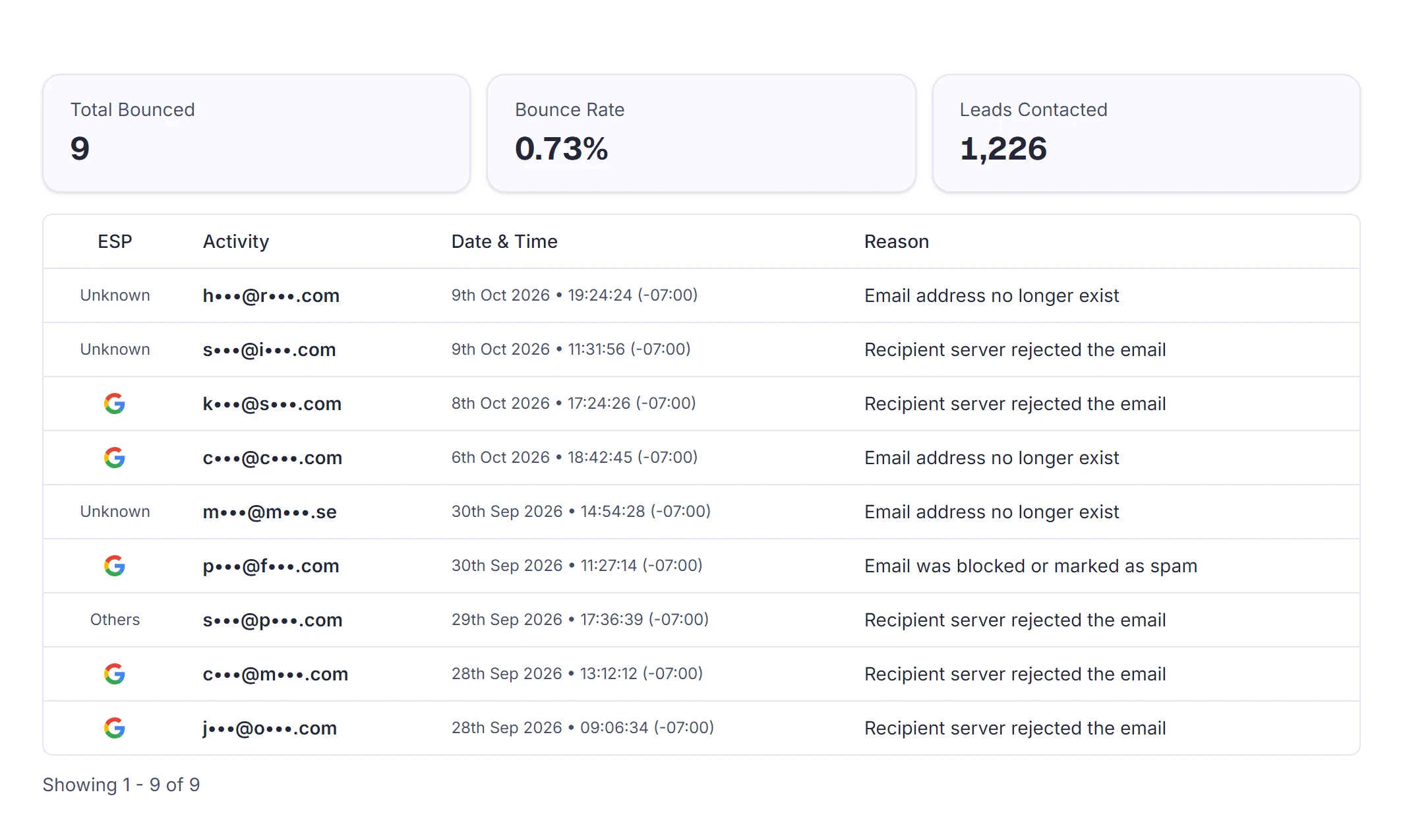
A reply rate this high is only possible when emails reach the inbox. Only 9 emails bounced, a 0.73% bounce rate, well under the 2% level generally considered safe. Only one of those 9 was a spam block.
| Bounce reason | Bounces |
|---|---|
| Recipient server rejected the email | 5 |
| Email address no longer exists | 3 |
| Blocked or marked as spam | 1 |
What made it work
Six lessons you can copy, each backed by a number from this campaign.
1. Write the first email to be answered (98.8% of replies)
Nearly every reply answered Email 1. It was short, plain text and read like a normal business email, with a specific subject line. Put most of your effort into the opener; the follow-up only tops it up.
2. Grow with domains, not volume per domain (55 a day)
Each domain sent to at most 55 new leads a day, spread across several mailboxes. To reach more people, add sending domains rather than raising the per-domain limit, so every mailbox stays at a volume providers trust.
3. Verify the list before the first send (0.73% bounce rate)
Only 9 of 1,226 leads bounced, and only one of those was a spam block. Bounces damage a domain faster than volume does, and a verified list kept them close to zero from day 1.
4. Let a reply end the sequence (421 follow-ups cancelled)
By 12 Oct, 421 scheduled follow-ups had been cancelled because the lead had already replied. Nobody who answered got a second pitch, which protects both the relationship and the sender’s reputation.
5. Judge a campaign after the replies stop (+63 replies after the pause)
Sending paused on 13 Oct, but publishers kept answering. On 12 Oct the campaign stood at 501 replies and a 42.53% reply rate. By 23 Oct it had 564 replies and 46.12%. Give a campaign a week or two after its last send before you judge it.
6. Send on a normal business schedule (Mon–Fri)
Emails went out on weekdays only, spread through the working day, with no tracked links. To mailbox providers and to recipients, that looks like a person’s outbox, not a bulk sender.
How we measured this
- Reply rate is the campaign-level figure from the Deliveryman dashboard: unique leads who replied, divided by leads contacted. It counts every reply, not only positive ones.
- Dates. The dashboard figures, sending log and bounces are from 23 Oct 2026. The sequence breakdown and the cancelled follow-ups are from an earlier reading on 12 Oct 2026.
- Open rate isn’t a measure here. The dashboard shows opens, but Email 1 was plain text, which can’t carry an open-tracking pixel, so opens mostly reflect the follow-up. Privacy features such as Apple Mail Privacy Protection and image proxies make opens unreliable anyway. Replies are the measure of whether a campaign worked.
- The client, its sending domains, its prospects and its full email copy are not shown, to protect the client’s privacy. Bounced lead addresses are masked.
Want replies like these? Deliveryman sets up your domains, warms them up and keeps every send in the inbox. See pricing.